Help for a Reactive or Aggressive Dog in Anchorage
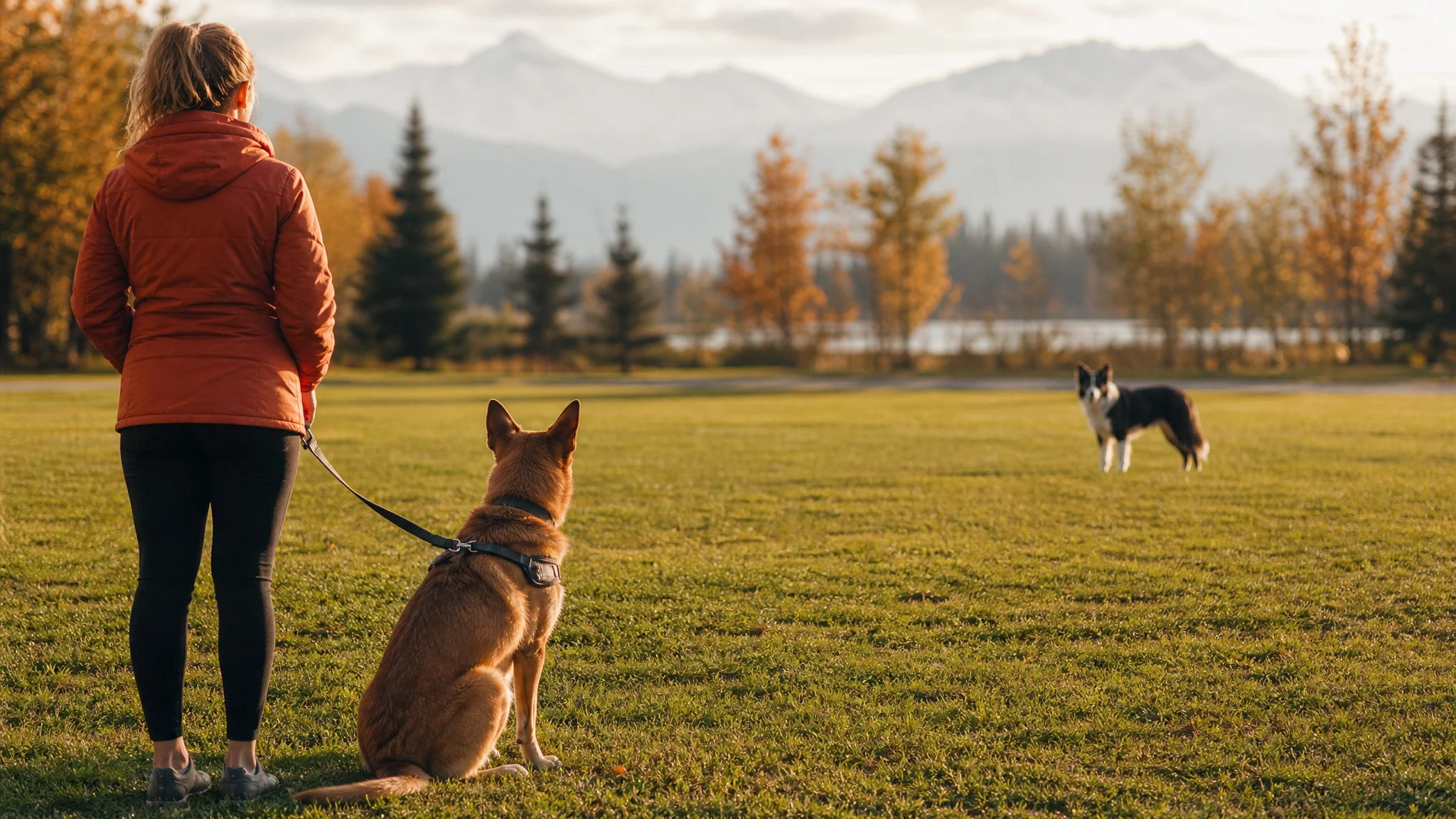
General training information. For aggression, sudden behavior changes or health concerns, see your veterinarian first.
Lunging, barking and growling at the end of a leash is stressful for you and your dog. If you live in Anchorage, it can feel even harder. Trails are shared, winter sidewalks are narrow, and a surprise dog or moose can show up around any corner.
This guide explains what reactivity and aggression are, how to keep everyone safe, and how reactive dog training works with reward-based methods. It also covers when to call a veterinarian and where to look for local help.
What reactivity and aggression mean
A reactive dog overreacts to a trigger. Common triggers are other dogs, strangers, bikes, skiers, strollers or loud noises. The reaction can look like barking, lunging, spinning or freezing. Most of the time, the dog is overwhelmed, afraid or frustrated.
Aggression is behavior meant to create distance or cause harm, such as snarling, snapping or biting. Reactivity can include aggressive displays, but not every reactive dog bites. The two overlap, and it is hard to tell them apart from the outside. That is one reason a professional's help is worth having.
Either way, the dog is not being stubborn or "dominant." The dog is communicating that something feels too close, too fast or too much.
Safety comes first
Before any training, set up your life so nobody can get hurt. Safety also lowers your dog's stress, and that helps learning.
- Keep the dog leashed or securely fenced at all times. In Anchorage, a closed gate is not enough if a moose, a loose dog or a child might reach the yard.
- Use baby gates or a closed door when guests visit.
- Never leave a dog with bite history alone with children.
- Do not punish growling. A growl is a warning, and a dog that learns to hide it may skip straight to a bite.
Why punishment makes it worse
The American Veterinary Society of Animal Behavior (AVSAB) recommends reward-based training and says punishment can increase fear, anxiety and aggression. Yelling, leash jerks, alpha rolls and scruffing are risky for a reactive dog. They add pain or fear to a moment that is already scary.
There is a practical reason too. If a dog barks at another dog and then feels pain, the dog may link the pain to the other dog. The next encounter can be worse. This guide does not recommend shock, prong or choke collars for any dog.
What you will need
- A flat buckle collar or a well-fitted, comfortable harness, and a standard 4 to 6 foot leash. Retractable leashes give less control.
- Small, soft, high-value treats such as tiny pieces of cooked chicken or cheese, in a pouch you can reach quickly.
- A notebook or phone to log triggers, distances and progress.
- A safe place to practice, such as a quiet street at off-peak hours.
- Optional: a front-clip harness or a head halter that your dog accepts calmly, introduced slowly with treats. Ask a trainer to check the fit.
- Warm layers and a headlamp in winter, so you can see what is ahead and stay relaxed.
Step-by-step: desensitization and counter-conditioning
Desensitization means exposing your dog to a trigger at a level so low that the dog stays calm. Counter-conditioning means pairing that trigger with something great, like food, so the dog starts feeling good about it. Together they are the core of most reactive dog training plans.
Step 1: Rule out pain and find the threshold
Start with a veterinary visit if the behavior is new or has gotten worse. Pain, thyroid problems and other medical issues can all change behavior.
Then find your dog's threshold. This is the distance at which your dog notices a trigger but can still take a treat and look at you. If the dog is barking, lunging or ignoring food, you are too close.
Step 2: Teach a few easy skills at home
Practice in a quiet room first. Useful skills include:
- Name response: say the name, then reward when the dog looks at you.
- Hand target: your dog touches your palm with the nose for a treat. This is a handy way to move the dog away from a trigger.
- "Let's go" U-turn: cheerfully turn and walk the other way, rewarding as the dog follows.
Build these over several days, then repeat them outside at low distraction.
Step 3: Start at a distance
Go to a spot where you can see triggers from far away, such as the edge of a large parking lot. The moment your dog sees the trigger, say "yes" and feed a treat. When the trigger leaves, the treats stop.
The pattern teaches your dog that the trigger predicts good things. Keep sessions short, around five to ten minutes.
Step 4: Reward calm choices
When your dog looks at the trigger and then looks back at you, mark and reward. Over many sessions, you can reduce the distance by small steps. If the dog stiffens or barks, add distance again. Going backward is part of normal progress, not failure.
Step 5: Use the escape route
Always have a plan to leave. Turn, reward and walk away before the dog explodes. Moving away calmly teaches your dog that you will take care of the situation, so the dog does not have to.
Step 6: Practice, then change one thing at a time
When your dog is relaxed at one distance for several sessions, try changing one variable: a slightly closer distance, a different location or a different type of trigger. Do not change several things at once.
Step 7: Manage between sessions
Every reaction at full volume is practice for the dog. Between training sessions, avoid the triggers where you can. Walk at quieter times, cross the street early, use a window film or a baby gate to block what the dog sees, and give plenty of chewing and sniffing outlets at home.
Anchorage-specific tips
Know the leash rule
The Municipality of Anchorage Animal Care & Control says that Anchorage Title 17 requires animals in public places to be under control. Control by leash includes a leash, chain or electronic collar that can physically restrain the animal. Off-leash is allowed only in a designated off-leash dog park space, or under control by command when specific criteria are met.
For a reactive dog, plan on keeping the leash on everywhere that is not a fenced yard. Check the Animal Care & Control leash page for the full wording.
Think twice about off-leash parks
Anchorage Parks and Recreation lists off-leash areas including Connors Bog, Russian Jack Springs Park, University Lake Park, Far North Bicentennial Park (North Gasline Trail), South Anchorage Sports Park, Chanshtnu Muldoon Dog Park, Whisper Faith Kovach Park, Valley of the Moon Park and Arctic Benson Park. Some are fenced and some are trails. The city page says that at some of them, owners must stay in the dog area, and dogs must be leashed entering and leaving. It also lists licensing and rabies vaccination for dogs at Russian Jack Springs Park.
A busy off-leash area can be a hard setting for a reactive dog, because you cannot control who approaches. Many owners do better using these spaces only when they are empty, if at all. The city page does not publish hours or fees, so check it before you go. It also says dogs are not allowed to swim at University Lake Park.
Watch for moose
Alaska's News Source reported that an Alaska Department of Fish and Game biologist warned of aggressive moose after a moose killed a dog in a fenced East Anchorage backyard in January 2023. The advice quoted was to keep a safe distance from moose, supervise dogs closely outdoors and not feed moose. Moose come into town in deep snow and can be stressed.
For a reactive dog, this means the "escape route" step matters even more. If you see a moose, calmly turn and leave, and do not let your dog bark or pull toward it.
Licensing and rabies vaccination
Animal Care & Control says all dogs 4 months and older living in the Municipality of Anchorage need a current license, and a license is valid only if the rabies vaccination is current. The municipality says state law also requires rabies vaccination for dogs over 4 months of age. Keeping both current matters even more if your dog has any bite history. Check the license page for fees and how to apply.
The Anchorage dangerous dog rule
Many owners of aggressive dogs worry about what the law says if a dog bites or threatens someone. I could not confirm the wording of the Anchorage rule for dangerous or classified dogs, so check it directly. Contact Anchorage Animal Care and Control at 4711 Elmore Road, Anchorage, AK 99507, or read the Title 17 animal code through the Municipality of Anchorage.
Municipal park rules also mention "classified dogs" being prohibited at some off-leash areas. Ask Animal Care & Control what that classification means and how it could apply to your dog. If your dog has bitten someone, do not wait. Speak with your veterinarian and a qualified professional, and ask the agency what your obligations are.
When to see a veterinarian or a veterinary behaviorist
See your veterinarian first if:
- The aggression or reactivity began suddenly or is getting worse.
- Your dog seems painful, stiff, or is eating, drinking or sleeping differently.
- Your dog has bitten or tried to bite a person.
Aggression toward people calls for both a veterinarian and a certified behavior professional. Ask your veterinarian whether a referral to a veterinary behaviorist makes sense. These are veterinarians with extra training who can diagnose and, when appropriate, prescribe medication alongside a training plan. I do not have a verified local veterinary behaviorist to list, so ask your veterinarian for a referral.
If your dog is injured or a bite just happened, treat it as an emergency and contact a veterinarian or emergency clinic.
Finding local training help
The trainers below are described only by what their own listings show. Their credentials come from a third-party directory or their own staff page. Before booking, ask each one directly whether they work with reactive or aggressive dogs, what methods they use and whether they take reward-based approaches only.
- Janelle Doggett, Alyeska Canine Trainers: listed on DogTrainerLocator.com with a CPDT-KA credential, in Anchorage.
- Justin Macias, Stay Frosty K9 Training: listed on DogTrainerLocator.com with a CPDT-KA credential, in Anchorage.
- Lucy Bailey: listed on DogTrainerLocator.com with a CPDT-KA credential, offering remote training for Anchorage.
- Sheryl Makelim, Alaska Dog Sports LLC: the business's staff page shows CCTBS and a CPDT-KA instructor credential, in Anchorage.
If you are comparing options and costs, see our guide to where to train in Anchorage and what it costs. I do not have published prices to share, so ask each trainer.
If you are thinking about a group class, ask about the facility's rules. Alaska Dog Sports, for example, states on its FAQ page that it requires proof of distemper and parvo vaccination for all dogs and proof of rabies vaccination by 4 months of age. For puppies 10 to 14 weeks old, one distemper/parvo vaccination is needed at least 7 days before entering. Puppies 15 weeks and older need two. Other facilities may have different rules, so check with each one.
Common mistakes to avoid
- Going too close, too fast. If your dog cannot eat, the trigger is too near.
- Using pain or fear. Corrections can suppress the warning signals while the fear remains.
- Forced greetings. "Let them work it out" can cause a serious fight or a worse fear.
- Skipping the vet. Pain is a common and fixable cause.
- Relying on dog parks. Unpredictable dogs are the hardest setting for a reactive dog.
- Expecting a straight line. Winter darkness, new triggers and a bad day can all cause setbacks.
- Tense leash handling. Your dog feels your tension, so breathe, keep the leash loose and move away calmly.
Tips for better sessions
- Keep training sessions short and end on a good note.
- Exercise and sniffing time before a session can help your dog settle.
- Use a consistent marker word like "yes" every time.
- Log distances and reactions so you can see progress that might not be obvious day to day.
- Let family members know the plan so everyone responds the same way.
What results to expect
Many dogs can improve with patient, reward-based work, but results vary from dog to dog. Progress may take weeks or months, and some dogs will always need management. Some owners notice their dog recovers faster after a trigger, looks at them more often or tolerates a closer distance over time.
No method can promise a particular outcome. A dog's history, genetics, health and environment all play a part. The goal is a calmer, safer life for you and your dog, with fewer surprises on your walks.
Sources
- Municipality of Anchorage, Animal Care & Control, Leash Law
- Municipality of Anchorage, Animal Care & Control, Dog License
- Municipality of Anchorage, Animal Care & Control, Rabies Vaccination
- Municipality of Anchorage, Animal Care & Control
- Municipality of Anchorage Parks and Recreation, Dog Parks
- Alaska's News Source, Fish and Game warns of aggressive moose after dog is killed
- Alaska Dog Sports LLC, FAQs
- Alaska Dog Sports LLC, Our Staff
- DogTrainerLocator.com, Janelle Doggett
- DogTrainerLocator.com, Justin Macias
- DogTrainerLocator.com, Lucy Bailey