Off-Leash Dog Parks in Anchorage and How to Train for Them
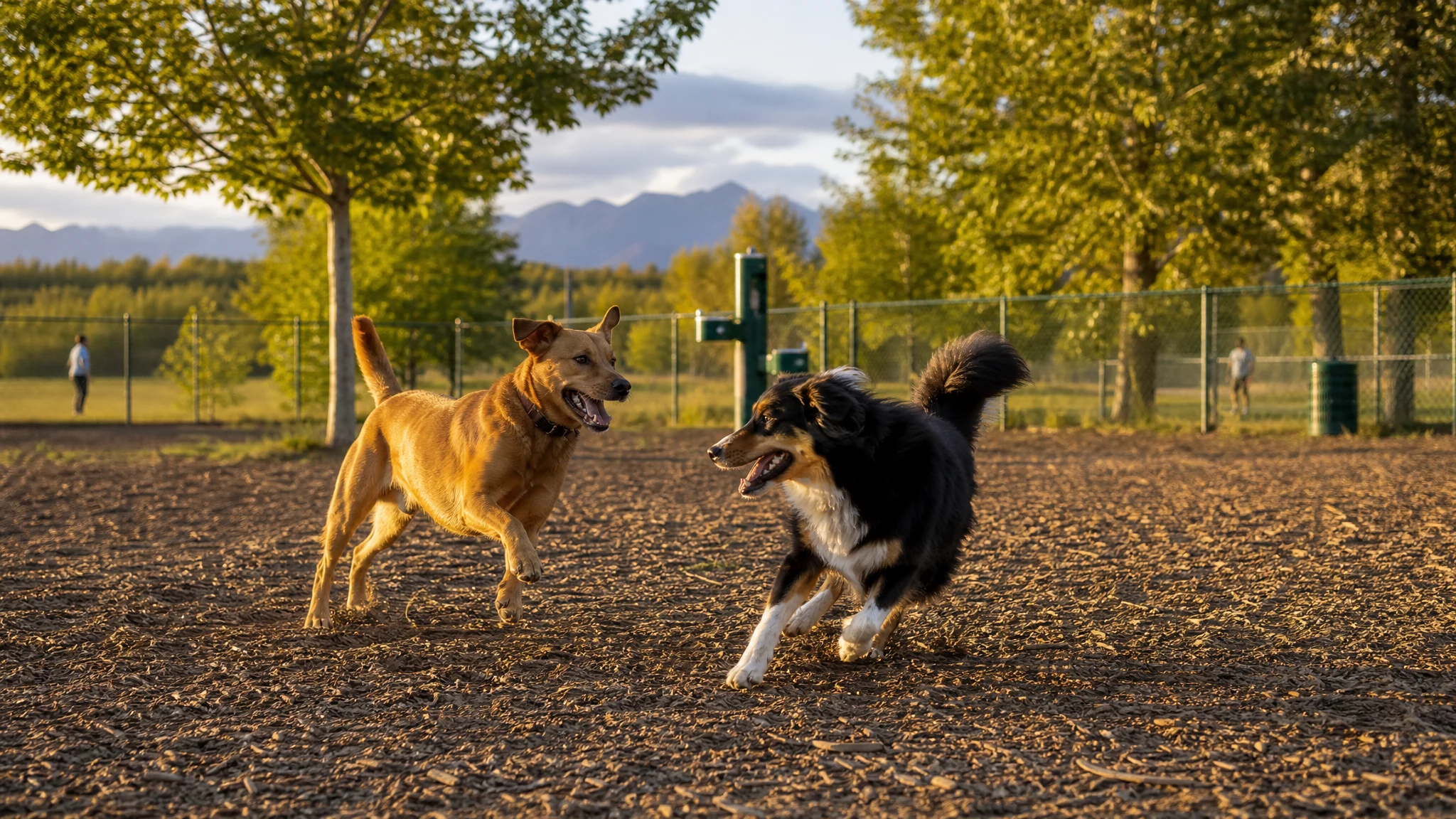
General training information. For aggression, sudden behavior changes or health concerns, see your veterinarian first.
Anchorage has more room for dogs to run than many cities its size. It also has long winters, moose in the neighborhoods and a leash law that expects you to stay in control of your dog at all times.
This guide covers the dog parks in Anchorage that the Municipality lists for off-leash use, the rules posted for them, and a step-by-step plan to get your dog ready. The training matters more than the park. A dog who comes when called and checks in with you can enjoy almost any open space safely.
What Anchorage Law Says About Dogs in Public
Start with the basics. According to the Municipality of Anchorage Animal Care & Control leash law page, Anchorage Title 17 requires animals in public places to be under control. Control by leash means a leash, chain or electronic collar that can physically restrain the animal.
The same page says off-leash is allowed in two situations. One is a designated off-leash dog park space. The other is control by command, which needs all three of these to be true:
- The animal is engaged in an activity that precludes it from being restrained.
- It is in an area normally associated with that activity.
- The activity is conducted in a way that minimizes impact on the public.
The page states no maximum leash length. For the exact code wording, check with Animal Care & Control.
License and rabies vaccination
Animal Care & Control says all dogs 4 months and older living in the Municipality need a current license, and a license is valid only if the rabies vaccination is current. The municipal vaccine page adds that state law requires rabies vaccination of dogs over 4 months of age.
The license page lists fees for one-, two- and three-year terms, with lower fees for sterilized dogs. Check that page for current amounts. Licenses can be issued online, by mail, or in person at Anchorage Animal Care and Control or participating veterinary clinics.
This matters for park use. The Parks and Recreation dog parks page says dogs at Russian Jack Springs Park must be licensed and have a current rabies vaccination, and the general off-leash rules for the other areas say the same.
Off-Leash Dog Parks in Anchorage
The Municipality of Anchorage Parks and Recreation dog parks page lists the areas below. It gives no street addresses, fees or hours for them, so check that page or the interactive map it links to before you go.
Fenced off-leash areas
- Chanshtnu Muldoon Dog Park: a fenced off-leash area with a separate enclosed section for small dogs under 25 lbs.
- Whisper Faith Kovach Park: a fenced off-leash area, also with a separate small-dog section for dogs under 25 lbs.
- Valley of the Moon Park: a fenced off-leash area.
- Arctic Benson Park: a fenced off-leash area.
- South Anchorage Sports Park: listed as both off-leash trails and a fenced off-leash area.
Off-leash trails and larger areas
- Connors Bog: off-leash use is limited to the designated area once skijoring trails are groomed. The page points to an interactive map.
- Russian Jack Springs Park: listed as an off-leash area, with the license and rabies requirement noted above.
- University Lake Park: listed as off-leash trails. Certain trails may be closed to off-leash use seasonally and will be posted. Swimming by dogs is prohibited.
- Far North Bicentennial Park (North Gasline Trail): listed as off-leash trails.
Rules that apply across the areas
The Parks and Recreation page lists these general rules for off-leash areas:
- Dogs must be leashed when entering and leaving.
- The owner must stay in the dog area.
- Dogs must be licensed and have a current rabies vaccination.
- Clean up your dog's waste.
- Classified dogs and females in heat are prohibited at some listed areas, including Connors Bog and Russian Jack Springs Park.
If you are not sure what "classified dogs" means for your dog, ask Animal Care & Control before you visit.
If you are choosing an off leash dog park near Anchorage neighborhoods you already know, think about the setup as well as the distance. A fenced area is a gentler place to start than open trails, because a missed recall has a safety net. Trail areas ask more of your dog.
What You Need Before You Start
- A flat buckle or harness and a standard leash for the leash-on, leash-off routine at park gates
- A long line (a light training line, not a retractable leash) for practicing recall in open spaces
- Small, soft treats your dog loves, cut pea-sized, and a treat pouch
- A current Anchorage dog license and proof of current rabies vaccination
- Waste bags
- A quiet practice area: your yard, a hallway, or a calm corner of a park
Use a regular collar or harness. Humane, reward-based training is the approach the American Veterinary Society of Animal Behavior (AVSAB) supports, and it is what this plan uses. Corrections and punishment-based tools are not part of it.
Step-by-Step: Training for the Off-Leash Park
Step 1: Build a reliable recall
Pick a word you will only use for coming back, such as "here." Do not use your dog's name as a scolding word.
Start indoors, a few steps away. Say the word once in a happy voice. When your dog turns toward you, praise. When your dog arrives, give three or four treats in a row. Repeat in short sessions of five minutes or less.
Add distance in small steps. Move to the yard, then the hallway of an apartment building, then a quiet park on the long line. Only add one challenge at a time: distance, distraction or a new place.
Never call your dog to end the fun and then do something unpleasant, like a bath or leaving the park. Call your dog back often, reward, then send your dog off to play again. That keeps coming back a good deal.
Step 2: Teach a check-in habit
A check-in means your dog looks at you on their own while out and about. Stand in a quiet spot with your dog on a leash. Each time your dog glances at you, say "yes" and give a treat. Do this until your dog starts looking at you first.
Then practice with mild distractions: a dropped toy, a person walking by at a distance. Reward every glance. Over time, your dog learns that staying aware of you pays off.
In the park, pay attention to where your dog looks. A dog who keeps checking in is usually easy to call. A dog who stops looking at you is telling you to shorten the distance or go back on the leash.
Step 3: Practice the leash-on, leash-off routine at the gate
The Parks and Recreation rules say dogs must be leashed entering and leaving, so make that routine calm. Many dogs get wound up at the gate, and a wound-up dog is harder to manage inside.
Practice at home first. Clip the leash on, ask for a sit, and wait for your dog to settle before you open the door. Reward calm. If your dog pulls or spins, close the door and try again. At the park, walk up to the gate, ask for a sit, and wait before you go in. Inside, unclip once your dog is calm.
Step 4: Learn to read dog play
You do not need to be a behaviorist to spot healthy play. Look for these signs:
- Loose, wiggly bodies and relaxed faces
- Dogs taking turns chasing and being chased
- Play bows, and short pauses where both dogs reset
- Both dogs choosing to keep going when play pauses
Watch for signs that play is going wrong:
- Stiff bodies, hard stares or freezing
- One dog trying to get away while another keeps following
- Several dogs piling on one dog
- A dog hiding behind you or pressing against your legs
If play looks tense, calmly call your dog away and give a break. A short pause is a good habit, even when play is going well. Trust your read of your own dog. If your dog is saying "this is too much," leave.
Step 5: Teach a calm leave
Leaving the park is where many owners struggle. Practice it on purpose.
Call your dog away from play several times per visit, reward, and let your dog go back. Then, when it is time to leave, call, reward, clip on the leash and walk out while giving treats along the way. A dog who has practiced coming away from fun many times finds the real exit less of a surprise.
Also teach "leave it" at home for dropped food and trash, and a solid "drop it" for toys. Ice, spilled snacks and winter debris can show up in public spaces, and a dog who can turn away from them is easier to keep safe.
Step 6: Visit when it is quiet, then build up
Your first visits should be short and calm. Go at a quiet time, stay for 10 or 15 minutes, and leave while your dog is still doing well. The parks page lists no hours, so check posted signs for any limits.
Begin with your dog on a leash outside the fence, letting your dog watch from a distance and earn treats for calm behavior. Next, try a fenced area with few dogs. Move to busier times only when your dog is handling the quiet ones well.
Anchorage-Specific Safety
Anchorage has risks that a generic dog park guide will not mention.
Moose
Alaska's News Source, quoting an Alaska Department of Fish and Game biologist, reported that a moose killed a dog in a fenced East Anchorage backyard in January 2023. The advice reported from Fish and Game was to keep a safe distance from moose, supervise dogs closely outdoors and not feed moose. The report noted that moose come into town in deep snow and are stressed.
In practice, that means a strong recall and a quick leash-up matter even more here. If you see a moose, get your dog on a leash and move away calmly. Do not let your dog approach it. A fence does not guarantee your dog is out of reach.
Water and closures
The Parks and Recreation page prohibits dog swimming at University Lake Park and advises awareness of lakes posted against dog swimming. Read the posted signs, and note that some trails may close to off-leash use seasonally.
Winter
Connors Bog's off-leash use is tied to groomed skijoring trails, so winter users share space with skiers and dogs in harness. Keep your dog close, leash up when you are unsure, and give working teams room. The sources for this guide do not cover ice, salt or cold exposure, so ask your veterinarian about winter paw care and how long your dog can safely stay out.
Tips and Common Mistakes
- Skipping the long line. Moving straight from the yard to off-leash practice sets your dog up to fail. Use a long line in open areas until recall is reliable.
- Using the park as the training place. A busy park is the hardest classroom. Train somewhere quiet and use the park to put it to use.
- Chasing your dog. Running after a dog who will not come often turns into a game. Move away, call in a cheerful voice, or crouch down and reward when your dog returns.
- Scolding after a late recall. If your dog finally comes, reward. Punishing a dog for arriving teaches the dog not to arrive next time.
- Staying on your phone. The rules say the owner must stay in the dog area. Stay present and watch your dog.
- Bringing a puppy too early. Check your puppy's vaccination schedule with your veterinarian first. Group classes often have their own rules. For example, Alaska Dog Sports says on its FAQ page that it requires proof of distemper and parvo vaccination for all dogs and rabies vaccination by 4 months of age.
When a Dog Park Is Not Right for Your Dog
Off-leash parks are optional. Many good dogs do better with leashed walks, one-on-one playdates with familiar dogs or trail hikes on a long line.
A dog park may not be a good fit if your dog:
- Is fearful, hides or tries to leave when other dogs approach
- Guards toys, treats or you from other dogs
- Cannot be called away from distractions yet
- Is a young puppy who has not finished vaccinations
- Is a female in heat, since the Parks and Recreation rules prohibit that at listed areas
- Is a dog classified under local rules, which the parks page also prohibits at some areas
If your dog growls, lunges or bites people, skip the park. See your veterinarian first to rule out pain or illness, then work with a certified behavior professional. If your dog is injured or suddenly acting unlike themselves, call your veterinarian right away.
What Results to Expect
Every dog learns at a different speed. With regular short practice sessions, many dogs become noticeably more responsive to a recall cue and more settled at the gate within a few weeks. Others, especially adolescents or dogs with strong prey drive, may take months, and some may always do best on a long line in open places.
Measure progress by how your dog behaves in each new setting rather than by the calendar. Results will vary with your dog's age, history and temperament, and no plan can promise a perfect recall around moose, squirrels or other dogs.
If you would like help, see our guide to dog training in Anchorage, where to train and what it costs. A group class or a private session can give you feedback on your timing and your dog's body language.
Quick Checklist Before You Go
- Dog is licensed, with a current rabies vaccination.
- You have checked the Parks and Recreation page for the area's current rules and closures.
- Your dog can come when called indoors, in the yard and on a long line outside.
- You have treats, a leash and waste bags.
- You have a plan for a calm entry, a calm exit and a reason to leave early.
Sources
- Municipality of Anchorage Parks and Recreation, Dog Parks
- Municipality of Anchorage, Animal Care & Control, Leash Law
- Municipality of Anchorage, Animal Care & Control, Dog License
- Municipality of Anchorage, Animal Care & Control, Rabies Vaccine
- Alaska's News Source, Fish and Game warns of aggressive moose after dog is killed
- Alaska Dog Sports LLC, FAQs